
why use many token when few do trick
Original skill made agents say less. Caveman 2 makes them read less too.
33.2% fewer provider-reported input tokens in a pinned Claude Code benchmark. benchmark_counterfactual
Keep your agent. Brain big. Context small.







See it ·
Install ·
Learn ·
Proxy ·
Pixel ·
Wrap ·
Docs ·
License
---
## See it
| 🗣️ Normal agent — 69 tokens |
 Caveman agent — 19 tokens Caveman agent — 19 tokens |
|
> The reason your React component is re-rendering is likely because you're creating a new object reference on each render cycle. When you pass an inline object as a prop, React's shallow comparison sees it as a different object every time, which triggers a re-render. I'd recommend using useMemo to memoize the object.
|
> New object ref each render. Inline object prop = new ref = re-render. Wrap in `useMemo`.
|
## Install
Two products. Pick one or both.
**1 · Save input** — Caveman Proxy shrinks what your agent *reads* before every provider call, with byte-exact recovery. BSL-1.1 runtime, MIT CLI.
```bash
npm install -g @caveman-ai/cli && caveman setup --install
caveman claude # or codex · gemini · aider · opencode · hermes · openclaw
```
**2 · Save output** — the skill, the original. Your agent *answers* in tight caveman-speak while code, commands, and errors stay exact. MIT, 30+ agents.
```bash
npx skills add JuliusBrussee/caveman
```
Other ways in — full installer with hooks, Windows, one agent only
The full installer also wires the Claude Code hooks and statusline, finds every supported agent on your machine, and is safe to rerun (Node.js 18+):
```bash
curl -fsSL https://raw.githubusercontent.com/JuliusBrussee/caveman/v2.3.1/install.sh | bash
```
Windows (PowerShell 5.1+):
```powershell
irm https://raw.githubusercontent.com/JuliusBrussee/caveman/v2.3.1/install.ps1 | iex
```
One agent only:
```bash
# Claude Code
claude plugin marketplace add JuliusBrussee/caveman && claude plugin install caveman@caveman
# Gemini CLI
gemini extensions install https://github.com/JuliusBrussee/caveman
# Codex, Cursor, Windsurf, Cline, and other skills-compatible agents
npx skills add JuliusBrussee/caveman --skill '*' -a codex --yes # replace codex with your agent profile
```
Full 30+ agent matrix, dry run, flags, verification, and uninstall: [INSTALL.md](./INSTALL.md).
## Where your tokens go
You have months of agent history on disk. `caveman learn` reads it and scores your setup. Local, read-only, no account.
```bash
caveman learn # Claude Code + Codex + Gemini CLI + opencode; aider via CAVEMAN_AIDER_ROOT
```

The report shows your Cave Score, every token sink ranked by flow with a one-line fix behind each row, how deep each session ran into its context window, a replay of what the fixes would have cut from your past sessions, and a list-price illustration of what the ranked sinks cost over 30 days.
```bash
caveman learn implement # hand the plan to Claude Code or Codex
```
`learn implement` opens your own agent with the plan and the `caveman-learn` skill, which instructs it to propose each fix as a diff, apply only on your yes, re-measure, and revert anything that did not lower tokens per turn. Caveman never makes your agent dumber to make it cheaper.
## Caveman Proxy
One command wraps your agent and routes provider traffic through a local proxy powered by Caveman Engine. In a pinned 54-run Claude Code benchmark it used **33.2% fewer provider-reported input tokens** than direct Claude Code while passing all 18 exact-answer checks. [Method, per-case results, and limits.](./docs/WRAP-BENCHMARK.md) `benchmark_counterfactual`
No code change, no Caveman backend: the proxy forwards each request to your chosen provider, and recovery copies stay on your disk. Claude Pro/Max OAuth credentials pass through to Anthropic as-is.
```bash
caveman claude # Claude Code + Codex + Gemini CLI + opencode; aider via CAVEMAN_AIDER_ROOT
```
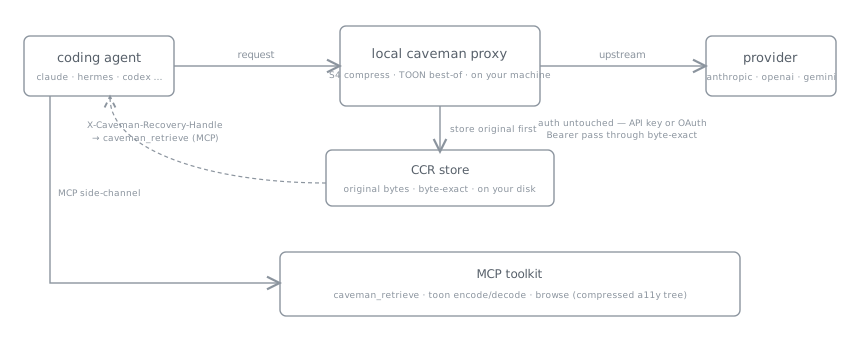
**What the engine does to a payload** — `detect()` types each payload, then routes it to a compressor that keeps what answers depend on:
| Detected type | Keeps | Target Savings|
|---|---|---|
| `json` | keys, structure, error/message subtrees; collapses repetitive arrays | 70–90% |
| `log` | errors, stack traces, first/last lines; drops INFO and progress noise | 85–95% |
| `code` | imports, signatures, types; elides function bodies, syntax stays valid | 40–70% |
| `diff` | file/hunk headers and changed lines; elides repeated context | 60–80% |
| `search-result` | top/bottom hits plus diagnostic/security hits | 80–95% |
| `text` / HTML | headings, opening/closing context, important sections | 50–80% |
`contextwindow.Pack()` additionally fits candidate context into a token budget by BM25 relevance, recency, and error signal, returned in original order so chronology survives.
The same engine powers a set of verbs:
```bash
caveman learn # scan your real agent history → score + ranked token sinks
caveman learn implement # fix the findings with your own agent, consent-gated per edit
caveman explore install # read-only FastContext subagent: finds code as path:line
caveman shrink -- pnpm test # compress noisy command output, byte-exact recoverable
caveman browse # local Chrome over a compressed a11y tree
caveman mem remember|recall # durable memory; `mem recover ` = original bytes
caveman trial -- claude # A/B a real session, then `trial report`
caveman toon encode|decode # the TOON re-encoder, standalone
caveman stats # what caveman actually did, by content type
```
The MCP server exposes five tools to any MCP host: `caveman_compress`, `caveman_retrieve`, `caveman_stats`, `caveman_toon_encode`, `caveman_toon_decode`.
On browse (needs Chrome): a focused query against a 200-row operations table costs **121 tokens, 129.8× smaller** than the Playwright ARIA baseline of 15,704. Full method: [`browse/BENCHMARK.md`](./browse/BENCHMARK.md).
## Pixel mode
### Skills as images
Full circle: the engine now compresses the thing caveman started as. Every fat skill you install re-loads its whole prompt body on every invocation, and you pay that tax forever. `caveman convert` renders each installed `SKILL.md` body to PNG pages in place. Frontmatter stays text, so discovery and triggering work exactly as before; the model reads the body as an image.
```bash
caveman convert --dry-run # every installed skill, with the token math, no writes
caveman convert --agent claude # convert the profitable ones
caveman convert --revert # byte-identical restore from SKILL.orig.md
```
Measured on the caveman skill itself: **1,069 → 415 est. tokens, −61%**. Convert only fires when pages beat the text; any failure leaves the skill byte-identical and names the gate that said no. New skills installed through `caveman skills install` auto-pixel by default (`--no-pixel` to opt out).
## The skill
The original, and still the fastest way to feel caveman. MIT forever. Works in [Claude Code](https://docs.anthropic.com/en/docs/claude-code), Codex, Gemini, Cursor, Windsurf, Cline, Copilot, and 30+ other agents.
Type `/caveman` if your agent does not activate it automatically. Switch with `/caveman lite|full|ultra|wenyan-lite|wenyan-full|wenyan-ultra`; turn it off with `/caveman off` or `normal mode`.
One install also brings the small tools:
| Tool / command | What you get |
|---|---|
| `/caveman [lite\|full\|ultra\|wenyan-lite\|wenyan-full\|wenyan-ultra\|off]` | Shorter replies at the intensity you choose. |
| `cavecrew-investigator`, `cavecrew-builder`, `cavecrew-reviewer` | Compressed subagent presets for locating, editing, and reviewing code. |
| `/caveman-commit` | Terse Conventional Commit messages. |
| `/caveman-review` | One-line, actionable review findings. |
| `/caveman-compress ` | Smaller Markdown memory files, with the original backed up. |
| `/caveman-stats` | Local session token usage and estimated savings in Claude Code. |
| `/caveman-help` | One-screen reminder of every mode and command. |
| `investigate-first`, `lean-build`, `surgical-patch`, `safe-refactor`, `migration`, `verify-and-stop` | Work patterns that write less code, so the agent bills fewer tokens. Your agent picks these up on its own when a task fits. |
| `/caveman-setup`, `/caveman-discover`, `/caveman-learn`, `/caveman-manage`, `/caveman-optimize`, `/caveman-explore`, `/caveman-evidence-review` | Drive the caveman engine and proxy: set it up, find where tokens go, act on what it finds. |
| Task | Normal | Caveman | Saved |
|------|-------:|--------:|------:|
| Explain React re-render bug | 1180 | 159 | 87% |
| Fix auth middleware token expiry | 704 | 121 | 83% |
| Set up PostgreSQL connection pool | 2347 | 380 | 84% |
| Explain git rebase vs merge | 702 | 292 | 58% |
| Refactor callback to async/await | 387 | 301 | 22% |
| Architecture: microservices vs monolith | 446 | 310 | 30% |
| Review PR for security issues | 678 | 398 | 41% |
| Docker multi-stage build | 1042 | 290 | 72% |
| Debug PostgreSQL race condition | 1200 | 232 | 81% |
| Implement React error boundary | 3454 | 456 | 87% |
| **Average** | **1214** | **294** | **65%** |
> [!IMPORTANT]
> **Honest number warning.** The skill only shrinks **output** tokens. Input and reasoning tokens are untouched, and the skill itself adds ~1–1.5k input tokens per turn. Whole-session savings run smaller than the output number, and on already-terse workloads they can go net-negative. The real win is **readability and speed**; cost savings are the bonus. When caveman wins, when it loses, and how to measure it yourself: **[docs/HONEST-NUMBERS.md](./docs/HONEST-NUMBERS.md)**.
## Wrap any agent
`caveman ` wraps eight agents natively. Adding one is a data change, a single JSON profile in [`agents/profiles/`](./agents/profiles/), no code.
| Agent | Vendor | How it's wrapped |
|---|---|---|
| **Claude Code** | Anthropic | env vars |
| **OpenAI Codex CLI** | OpenAI | env vars (API key) · ephemeral `CODEX_HOME` (ChatGPT login) |
| **Gemini CLI** | Google | env vars |
| **Aider** | OpenAI/Anthropic | env vars |
| **opencode** | sst | inline config via env, your `opencode.json` untouched |
| **Hermes Agent** | Nous Research | `--provider custom` + env |
| **OpenClaw** | OpenClaw | ephemeral merged config, your config read-only |
| **Pi** | pi.dev | bundled native extension, your `~/.pi` config untouched |
Wrap never edits your own config files. Real sessions round-trip in record mode, tested against **Hermes v0.18.0**, **OpenClaw 2026.6.11**, and **Pi 0.84.2**.
Not on the list? Point any provider SDK or framework (Vercel AI SDK, LangChain, LiteLLM, OpenAI Agents, CrewAI, PydanticAI) at the local proxy with a `baseURL` swap: [`integrations/recipes/`](./integrations/recipes/).
The default wrap hands the agent the whole loadout: the five caveman MCP tools, the browse MCP server when Chrome resolves, command-output shrink through a real hook on Claude, opencode, Gemini, Hermes, and OpenClaw (Codex gets an honest soft note, its runtime rejects the rewrite: [openai/codex#18491](https://github.com/openai/codex/issues/18491)), and [skills-as-images](#skills-as-images) on new skill installs. Turn pieces off in `~/.caveman-cloud/config.json`.
## The whole cave
One idea. **Agent do more with less.**
| Repo | What it shrinks | Status |
|------|------|------|
| [**caveman**](https://github.com/JuliusBrussee/caveman) *(you here)* | What the agent **says**, and now what it **reads** | live |
| [**caveman-browse**](https://github.com/JuliusBrussee/caveman-browse) | What the agent **sees in the browser** | live |
| **caveman-agent-sdk** | What your production agent **loads, calls, and spends** | own repo · in dev |
| [**cavegemma**](https://github.com/JuliusBrussee/cavegemma) | The compression **baked into weights** (Gemma fine-tune) | labs |
| [**caveman-code**](https://github.com/JuliusBrussee/caveman-code) | The **whole agent**, end to end | frozen |
| [**cavemem**](https://github.com/JuliusBrussee/cavemem) | What the agent **remembers**, across sessions | frozen |
| [**cavekit**](https://github.com/JuliusBrussee/cavekit) | The **build loop**, spec-driven | frozen |
Frozen repos still install and work; they are no longer in active development. Their best ideas live on here: cavemem's compressed-memory core ships inside caveman, and caveman-code's lesson became `caveman wrap`. Make the agent you already use cheaper instead of replacing it.
**Caveman make token small. Caveman Cloud make it _provable_.**
Local runtime results report `inferred`; controlled benchmark results report `benchmark_counterfactual`. Neither is a provider invoice. Caveman Cloud is where qualifying live evidence can become `verified`: baseline in record mode, changes behind eval gates, rollback on quality loss, savings from real traffic with signed receipts. Offline caveman never says `verified`.
[**Join the waitlist → caveman.so**](https://caveman.so)
## Privacy
Your agent still talks to the provider you chose. Local compression needs no Caveman account. The `caveman` CLI sends anonymous usage stats by default: which commands ran, plus token counts through and cut. Never your prompts, code, or file paths. It says so on first run, and one command turns it off forever: `caveman telemetry off` (or `DO_NOT_TRACK=1`). Skill and hooks run locally; the proxy forwards provider traffic; CCR stays in a SQLite file on your disk. Exact network, telemetry, and storage boundaries: [SECURITY.md](./SECURITY.md).
## License
Split license. Skill and adoption surfaces are [MIT](./LICENSE). Engine-linked runtime is BSL-1.1 source-available, not OSI Open Source before Change Date.
**MIT** — the skill, Agent SDK and initializer, the CLI, both client SDKs (TS + Python), kit, evals/graders, contracts, provider catalog, the extension shell, and the thin cavemem clients.
**BSL-1.1** — Engine, Proxy, Cache Engine, rewriter, Browse, MCP server, `shrink`, cavemem Go core, and shared Go platform. New Engine-linked runtime modules default to BSL-1.1. Source-available: read it, fork it, self-host it for your own first-party traffic free, production included. Every BSL version auto-converts to **Apache-2.0** on the earlier of `2030-06-21` or four years after that version first ships. Third-party hosted, managed, or embedded service use needs commercial license. BSL text and per-directory map ship with source.
`engine/pixel` embeds [pxpipe](https://github.com/teamchong/pxpipe) (MIT) plus glyph atlases derived from Spleen 5×8 (BSD-2-Clause) and GNU Unifont (dual OFL-1.1 / GPLv2-with-font-exception); its `NOTICE` travels with that source.
"Caveman" and the rock logo are trademarks of Julius Brussee. "Powered by Caveman" is fine when true.
## Star this repo
Caveman save you token, save you money. Star cost zero. Fair trade. ⭐
[](https://star-history.com/#JuliusBrussee/caveman&Date)
---
Docs:
Technical manual ·
Install matrix ·
Honest numbers ·
License ·
Contributing ·
Maintainer guide ·
Issues
MIT skill · BSL-1.1 engine — few token. no lie.